Permits for a kitchen countertop swap in Toronto
Last updated: By The Slab Desk
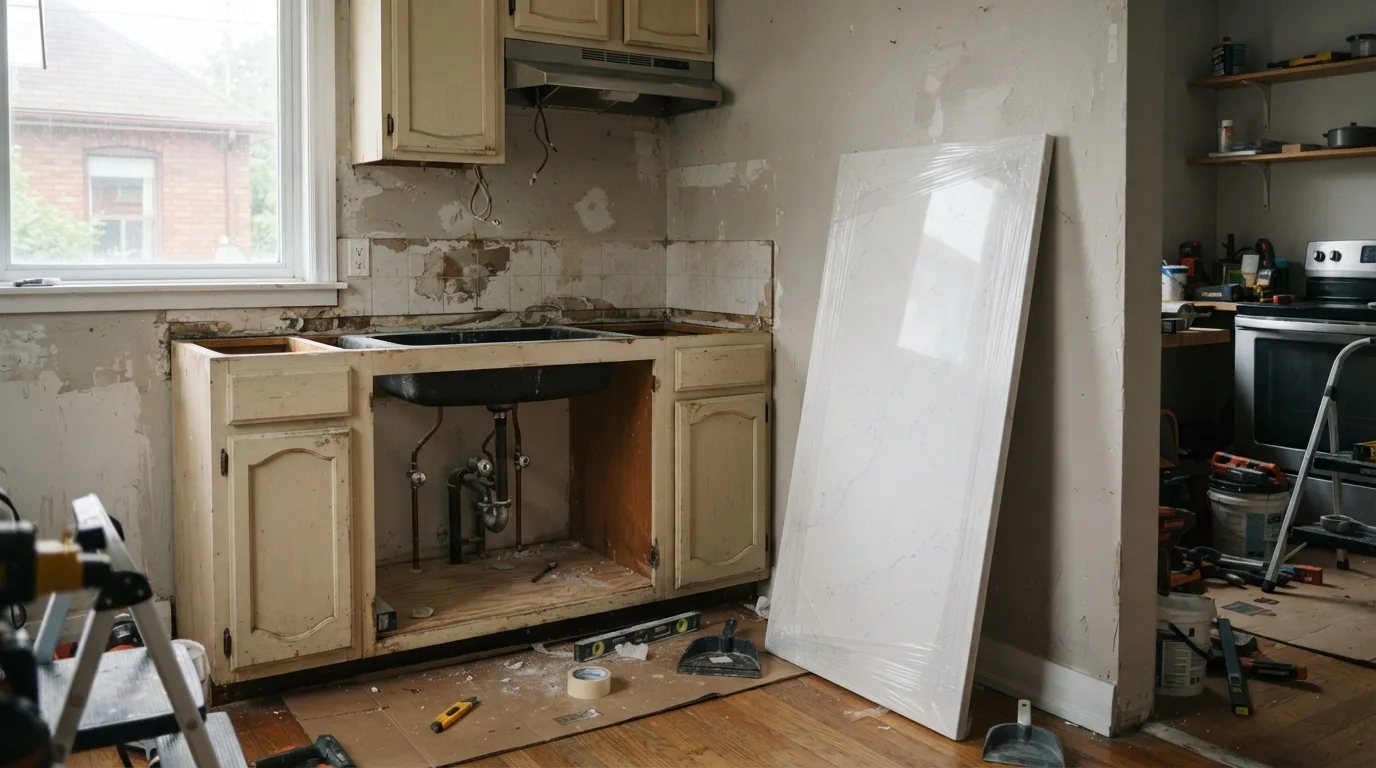
A like-for-like countertop replacement needs no City of Toronto building permit on the sources checked here. The City's list of permit-free work does not name countertops. This article reads its cabinetry and millwork entry as covering a new top on existing cabinets, and two contractors say so directly. Moving the drain needs a plumbing permit, and electrical changes go to the Electrical Safety Authority.
What the City's exempt list covers
The City of Toronto publishes a list of work that does not require a building permit. Its two closest entries for a countertop job are installation of cabinetry and millwork, and repairing and replacing plumbing fixtures. A new slab on existing cabinets, with the sink going back into the same opening, fits that reading. Adept Renovation & Painting, a Toronto renovation contractor, lists replacing cabinets and countertops in the same layout as work that does not need a building permit. Josh Kitchen, a GTA kitchen and cabinet company, reports in its countertop guide that in most GTA municipalities, simply replacing countertops does not require a building permit.
The City adds two qualifications. It says the exempt list is not exhaustive and that judgment should be used depending on the situation. It also says compliance with the Zoning Bylaw is required even where a building permit is not. A sink shifted a few centimetres along the same run to suit a new cut-out is named on neither list, so that case is a question for Toronto Building.
Moving the drain needs a plumbing permit
The City's list of work that does require a permit includes structural or material alterations and installing or modifying heating or plumbing systems. A drain moved to the middle of a new island changes the plumbing system, so that job needs a permit. Three nearby changes come up on countertop jobs:
- Adding a dishwasher where there was none: Adept's cost guide lists a plumbing permit as required for moving sinks and adding dishwashers.
- Replacing an existing dishwasher: this sits closer to the City's exempt entry for replacing plumbing fixtures.
- Moving a gas cooktop to a new cut-out: this is gas work, and TSSA, Ontario's fuels safety regulator, says only TSSA-registered fuels contractors can legally do fuels-related work in Ontario.
Keeping fixtures in place also has a budget effect. Adept reports that keeping the sink, stove and plumbing where they are saves $5,000 to $15,000 against relocating them. The kitchen renovation cost guide sets out the rest of that budget, and the countertop installation cost guide covers what a swap alone runs.
What the City permit costs
The examples below are separate cases, not one bill. A sink move with no other alterations can go on a stand-alone plumbing permit. The City's 2026 fee schedule prices plumbing fixtures at $23.20 each in a single family dwelling and $30.94 each in all other buildings. A minimum fee of $214.79 applies to all work, so a single fixture alone pays the $214.79 minimum.
Buried piping has its own line. For a single family house, the schedule sets a $214.79 flat fee for repairs, replacement and additions of buried plumbing and drainage piping. Ask about that line if the new drain runs under a basement or ground-floor slab.
Work that also alters walls or finishes is an interior alteration, which the schedule lists as partitions and finishings. The City's 2026 rate for a residential building, Group C, is $11.53 per square metre, counted over the total area affected by the proposal. A 12 square metre kitchen alteration calculates to about $138, under the minimum. The City's interior alterations guide asks for any plumbing to be submitted on a Plumbing Data Sheet with that building permit application.
Construction without a permit carries its own charge. The City's schedule sets it at 50% of the permit fee or $214.79, whichever is greater, up to $29,456.99 per permit.
Adept's cost guide prices a City building permit for wall removal, structural beams or layout changes at $400 to $2,500. It puts a plumbing permit at $150 to $400, and the low end of that range is below the City's minimum. For a sink move alone, the City's schedule sets the fee.
Electrical goes to the Electrical Safety Authority
Under the Ontario Electrical Safety Code, electrical work must be reported to the Electrical Safety Authority by filing a notification of work before the work starts. ESA says whoever is doing the electrical work must be the one to file it. A kitchen that adds a receptacle for an island needs that notification, even when the countertop itself needs nothing.
ESA names one warning sign for homeowners. It is a red flag if a contractor asks you to file a notification of work in your own name, because the contractor could be unlicensed. Who may do electrical work at all is covered in is countertop installation a licensed trade in Ontario. On a countertop job the question comes up when an outlet is added for an island or a cooktop circuit is altered for a new cut-out.
Condo kitchens may need the building's approval
Adept reports that on a condo kitchen renovation, the board or condo management approval process adds 2 to 4 weeks and often requires proof of insurance and WSIB. Its condo advice is to keep the sink and stove where they are. It names moving a sink through a concrete slab as the single biggest cost driver in a condo kitchen, often $5,000 to $10,000 alone.
Whether a countertop-only swap needs the building's approval depends on the building, so ask the property manager before booking the template. Raise a sink move first, since it can mean cutting through the slab. Elevator booking, deposits, working hours and getting the slab into the building are covered in installing a countertop in a Toronto condo.
Timing, paperwork and inspection
For a permit-free swap the calendar is short. Josh Kitchen puts custom fabrication at one to two weeks after measuring. Installation takes one day, and the kitchen is typically unusable for one to two days. The same guide allows one to two extra days if plumbing or electrical work is involved. Teccorp Stone, a Toronto countertop company, says final sink and appliance specifications should be available before templating to reduce the risk of revisions or re-fabrication. If a permit is needed, make sure the templated sink position matches the one in the application. The full sequence is in how long a countertop job takes in the GTA.
For a one- or two-unit house, a plumbing permit is filed with a Plumbing Data Sheet. The City says no plumbing plans are required for those houses unless the project includes a reverse-sloping driveway. All other residential plumbing and drain permit applications must include drawings showing the layout of plumbing and related fixtures on each floor level. An interior alteration permit needs its own drawings, drawn to scale, fully dimensioned, signed and dated. The application is signed by the owner or the owner's authorized agent.
The City's Express Services list includes stand-alone plumbing and drain permits and interior alterations for a Part 9 house with up to two dwelling units and no active building permit for a new residential building or addition. Toronto Building's goal is to review eligible applications within 3 business days after intake, which makes Express the likely route for a sink move in such a house. House projects that do not qualify for Express go to the House Stream, reviewed within 10 business days once complete. The City counts those applications complete only when they include an issued Zoning Applicable Law Certificate.
Permitted work is inspected. The City says inspectors must be able to see the part of the work under inspection. Anything covered before its mandatory inspection will have to be uncovered for inspection and passed. If the moved drain has a mandatory inspection, book it before the new countertop and sink cover it. The order of trades on install day is in who disconnects the plumbing on countertop installation day.
What to ask the installer before signing
No listing among the 876 in the index records who handles permits, ESA filings, inspections or gas work. Put these questions to the installer:
- Does the sink, a dishwasher or the cooktop move, or does everything go back in place?
- If a City permit is needed, who applies for it?
- Who books the City inspection, and will it happen before the new top goes on?
- If any electrical work is involved, who files the ESA notification of work?
- Who disconnects and reconnects the gas cooktop, and are they TSSA-registered?
- In a condo, does the building need to approve the work?
Outside the City of Toronto
The fee schedule and review times in this article are the City of Toronto's. North York and Scarborough are inside the City of Toronto. Vaughan, Mississauga and Brampton each sit outside it, so a homeowner there should check with their own municipality's building department before work starts.
The electrical rule does not change at the city line. ESA's notification requirement comes from the Ontario Electrical Safety Code, which applies across Ontario.
Frequently asked questions
Do I need a building permit to replace a countertop in Toronto?
- Not for a same-layout swap. The City's permit-free list covers cabinetry and millwork and replaced plumbing fixtures, which this article reads as including a new top over the same sink. Two contractors say the same about countertops directly. Moving the drain does need a plumbing permit, and an unusual scope is a question for Toronto Building.
What turns a countertop swap into permitted work?
- Changing the plumbing. Moving a sink or adding an island sink modifies the plumbing system, which the City lists as work that needs a permit. A new electrical outlet is a separate matter. The person doing the electrical work files a notification with the Electrical Safety Authority before starting, and the City's building permit does not cover it.
What does the City of Toronto charge to permit a sink move in 2026?
- For a single fixture alone, the $214.79 minimum. The City's 2026 fixture fees of $23.20 in a single family dwelling and $30.94 in other buildings both sit below that minimum. A single family house also has a separate $214.79 flat fee for buried drain piping, so ask whether the new drain runs under a slab.
Do condo owners need the building's approval?
- Possibly, depending on the building. A Toronto renovation contractor's cost guide puts board or management approval at 2 to 4 weeks on a condo kitchen renovation, often with proof of insurance and WSIB. Ask the property manager before the template is booked, especially if the sink is moving through the concrete slab.
Do I need a permit outside the City of Toronto?
- Check with your own municipality's building department, because the rules follow where the house is. The fees and review times in this article are the City of Toronto's, and Vaughan, Mississauga and Brampton sit outside it. Josh Kitchen reports that most GTA municipalities do not require a building permit for a straight countertop replacement.
Sources
Several of these sources are GTA companies that also have listings in this directory. They are cited for what their own pages publish, and being cited has no effect on where a listing appears.
- The City's list of work that does not require a building permit includes repairing and replacing plumbing fixtures and installation of cabinetry and millwork; the list is not exhaustive, and Zoning Bylaw compliance still applies. City of Toronto - When Do I Need a Building Permit?
- A building permit is required to make structural or material alterations and to install or modify heating or plumbing systems. City of Toronto - When Do I Need a Building Permit?
- In 2026, plumbing fixtures cost $23.20 each in a single family dwelling and $30.94 in all other buildings, buried plumbing and drainage piping for a single family dwelling is a $214.79 flat fee, interior alterations in Group C cost $11.53 per square metre, a $214.79 minimum applies to all work, and construction without a permit is charged 50% of the permit fee or $214.79, whichever is greater, to a maximum of $29,456.99. City of Toronto - Building Permit Fees (effective January 1, 2026)
- A plumbing permit for a one- or two-unit house is filed with a Plumbing Data Sheet and no plans are required except for a reverse-sloping driveway; all other residential plumbing applications must include drawings of the plumbing layout; interior alteration drawings must be to scale, fully dimensioned, signed and dated. City of Toronto - Interior Alterations (permit application guide)
- Stand-alone plumbing and drain permits and interior alterations for a Part 9 house with up to two dwelling units and no active permit for a new building or addition qualify for Express Services, with a goal of review within 3 business days; House Stream applications are reviewed within 10 business days once complete, which requires an issued Zoning Applicable Law Certificate. City of Toronto - Building Permit Review Streams
- Inspectors must be able to see the work under inspection, and anything covered before its mandatory inspection will have to be uncovered for inspection and passed. City of Toronto - About Building Inspections
- Electrical work must be reported to ESA by filing a notification of work before the work starts, whoever does the work must file it, and a contractor asking you to file in your name is a red flag. Electrical Safety Authority (Ontario) - Finding the Right Contractor
- Only TSSA-registered fuels contractors can legally do fuels-related work in Ontario. Technical Standards and Safety Authority (TSSA) - Consumer Safety
- In most GTA municipalities simply replacing countertops needs no building permit; custom fabrication takes 1 to 2 weeks and installation one day, plus 1 to 2 days if plumbing or electrical work is involved. Josh Kitchen - Countertop Replacement Toronto: Costs, Materials and Permits
- Replacing cabinets and countertops in the same layout needs no building permit; a plumbing permit is required for moving sinks and adding dishwashers; a building permit for wall removal or layout changes runs $400 to $2,500 in City fees; condo board or management approval adds 2 to 4 weeks on a condo kitchen renovation. Adept Renovation & Painting - Kitchen Renovation Cost Toronto 2026
- Final sink and appliance specifications should be available before templating to reduce the risk of revisions or re-fabrication. Teccorp Stone - Kitchen Countertop Cost in Toronto