How a granite slab becomes a kitchen countertop
Last updated: By The Slab Desk
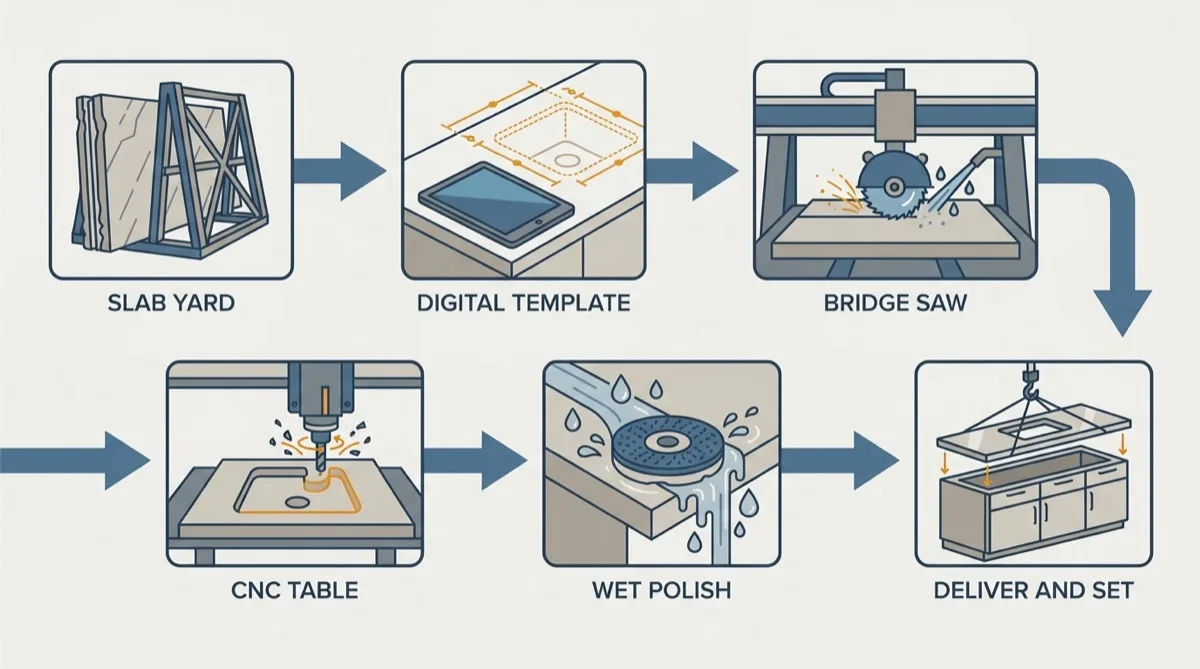
A granite countertop is made in a shop, not in a kitchen. A slab is chosen at a yard, the room is digitally templated after the cabinets are set, and that template drives a bridge saw and a CNC table. Cutting, machining and wet polishing all happen at the shop. What arrives at the house is finished pieces.
Who does this work in the GTA
Of the 876 companies in the index, 77 sit in stone fabrication and 120 in granite countertops. How far those two lists overlap is not a figure the site publishes, so read them as two separate counts rather than one population. A company can be listed for granite and buy its cut pieces from someone else's saw.
The business labels Google Maps attaches to these records show the split more plainly than the site's own categories do. Across the index there are 43 records labelled granite supplier and 32 labelled stone supplier, against 41 labelled countertop contractor and 88 labelled countertop store. Suppliers hold slabs. Contractors cut and set them. Stores sell the outcome. In practice a GTA homeowner walks into all three kinds of business while shopping for one countertop, which is why quotes for what looks like the same job arrive structured so differently.
The index counts companies of every kind by area rather than fabricators specifically, and it publishes no fabrication-only geography, so it cannot tell you where the saws are. On the all-company count Vaughan holds 97, Mississauga 93, North York 92 and Brampton 71. Names in the stone fabrication category run across all of those: Marble Guys in Etobicoke, Hilltop Surfaces in Mississauga, Apex Custom Fabrication in North York, Master Marble Corp in Brampton, Stone and Onyx Fabricating in Vaughan, Elements of Stone in Pickering. The index records what each is listed for and where it sits, and nothing about the machinery on any given floor.
The slab comes first, and it is bought by area
Granite reaches the GTA as a cut and polished slab, quarried and slabbed overseas, imported by a distributor and racked upright in a yard. What a homeowner chooses is a specific slab, or a pair of consecutive slabs from the same block if the kitchen is large enough to need two and the pattern has to run continuously.
Price at that stage is material only. Floorence Tile and Slab, a Toronto slab supplier, prices slab supply at $30 to $120 per square foot across granite, quartz and marble, with granite in the $30 to $70 part of that band, and separately puts slab installation labour at $25 to $60 per square foot. That second figure is the whole point of this article: shop and site labour is roughly a third to a half of a finished stone countertop in Toronto, which is why two quotes on an identical slab can differ by thousands of dollars.
Buying the two halves separately is possible and rarely a bargain. Split the purchase and you are paying a yard for material and a shop for labour, and you personally carry the cost of breakage, bad yield and any seam that lands somewhere the kitchen did not want it. A fabricator quoting one installed number is absorbing that risk. The breakdown of what fabrication itself costs is the clearest place to see how those two lines usually sit inside one price.
Templating is the production reference
Nothing gets cut until the kitchen has been measured, and the kitchen cannot be measured until the base cabinets and any island are installed, secured and levelled. That is the hard sequencing constraint in every countertop job. Unfinished or unlevel cabinets do not delay the template by a day, they force a return visit, and the fabrication clock restarts from the second visit.
Templating in the GTA is usually digital, and most shops fold it into the installed price rather than billing it. Natural Stone City reports Ontario shops charging roughly $100 to $300 for custom templating or specialised fabrication when it is billed as its own line. If a shop does charge it, ask whether the fee is credited against the job when you sign the order.
The template that comes off that visit is the production reference. Every subsequent operation, the saw path, the machined openings, the edge run, the seam positions, is generated from it. Teccorp Stone is blunt about what follows: a change made after cutting starts can mean re-fabricating a section at full cost. Sink, faucet and cooktop all have to be settled before the templater arrives, because their physical dimensions become geometry in the file.
Bridge saw, CNC and wet polish
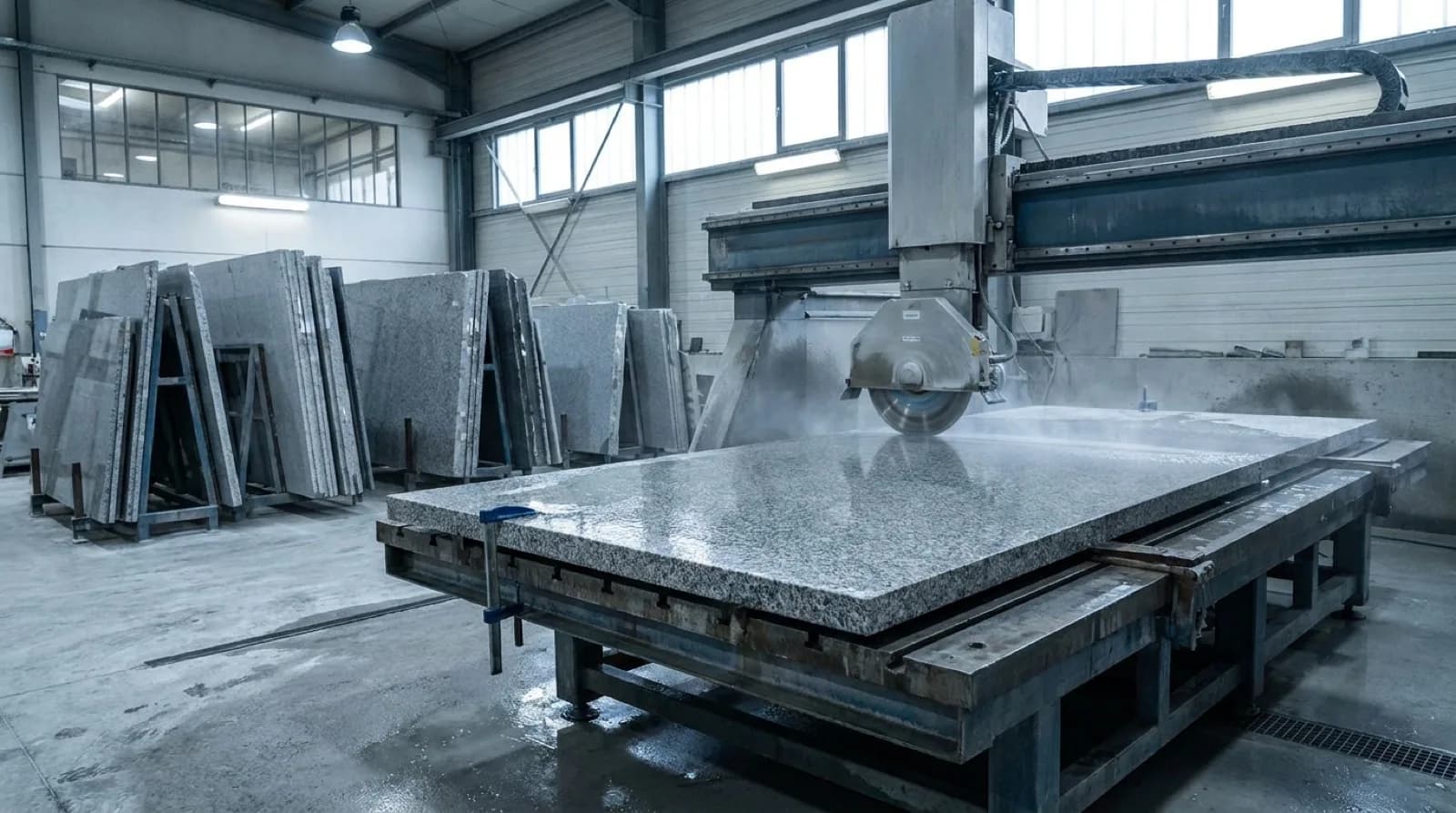
The first machine the slab meets is a bridge saw, a diamond blade on a moving gantry that cuts the large rectangles and the long straight runs. The second is a CNC table, a computer-driven router that machines the shapes a straight blade cannot: sink openings, faucet holes, radiused corners, cooktop cut-outs and profiled edges. Then the cut edges are ground and wet polished through progressively finer diamond pads until the exposed edge matches the factory-polished face.
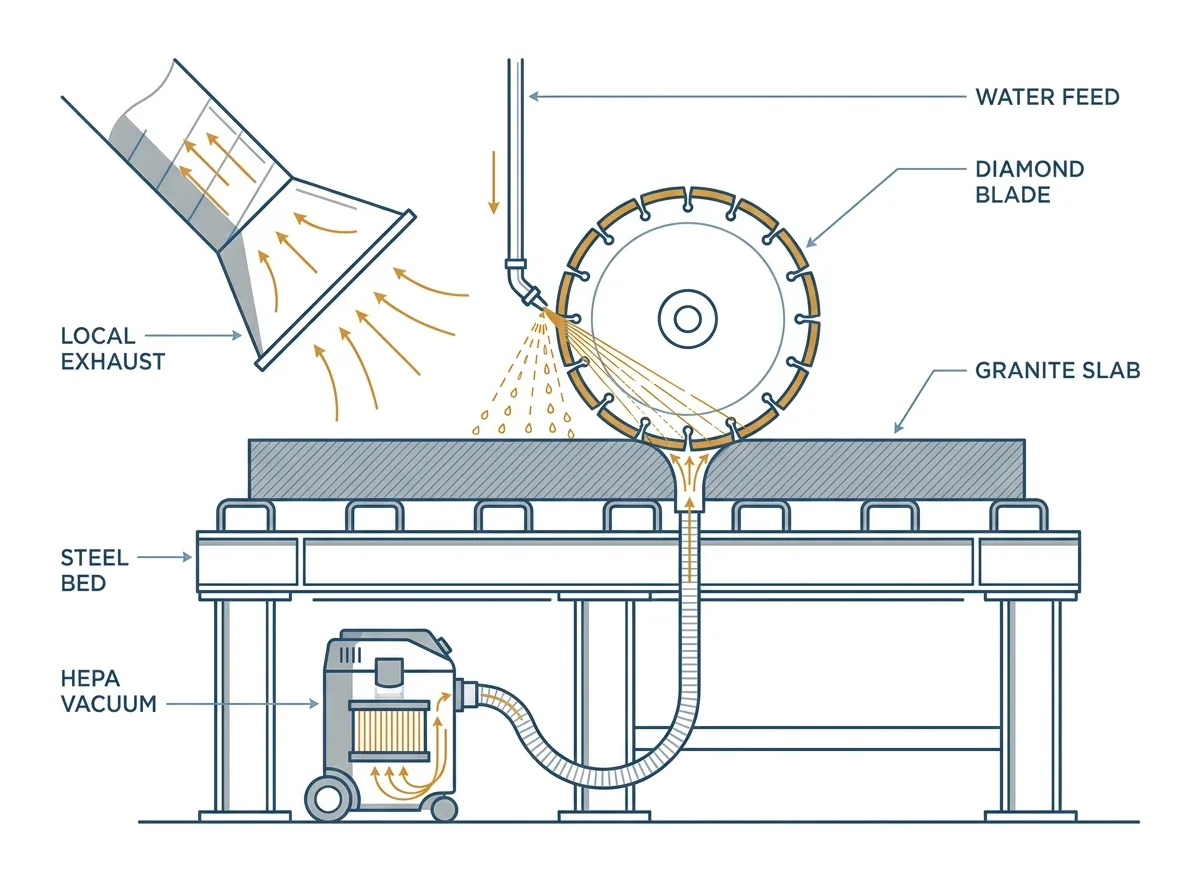
Every one of those operations is done wet, and that is a regulatory requirement rather than a preference. Silica is a designated substance in Ontario. Under O. Reg. 490/09 the occupational exposure limit is 0.10 mg/m3 for quartz as an eight-hour time weighted average and 0.05 mg/m3 for cristobalite, and employers must run a formal assessment and control programme. In practice, following the CCOHS control hierarchy, a compliant shop runs wet cutting, local exhaust ventilation, HEPA vacuums, a ban on dry sweeping and compressed air, and a fit-tested respirator programme with a clean shaven policy.
How much that bites depends on the material. CCOHS puts engineered stone at 90 to 97 percent silica, granite at under 45 percent and marble at usually under 5 percent. Granite therefore sits in the middle: far less hazardous to machine than quartz, far more than marble, and squarely inside the same shop controls. That cost is baked into the per square foot fabrication rate, which is one reason a licensed GTA shop cannot match a garage operation on price.
Why the serious cutting never happens in your kitchen
Ontario's rules split the fabrication shop from the job site, and the split explains the whole shape of install day. O. Reg. 490/09 covers the shop. It does not apply on a construction project, where the general duty in section 25(2)(h) of the Occupational Health and Safety Act applies instead. A shop can build a controlled environment around a saw. A kitchen with a dishwasher in it cannot.
The pricing data says the same thing from another direction. Across Toronto, GTA and Ontario sources, no shop published an on-site fabrication surcharge, because there is essentially no on-site fabrication to price. Bridge saws, CNC tables and wet cutting live in the shop, and what happens at the house is placement, seam joining and minor adjustment. If a crew arrives planning to cut a sink opening on your driveway, that is a different job from the one this market normally sells.
Install day is short for the same reason. Stone Wizards reports a typical 3 to 5 day turnaround in Toronto, Stone Valley Countertops offers roughly one week from template to installation, and Josh Kitchen puts custom fabrication at 1 to 2 weeks with installation completed in a single day and the kitchen unusable for 1 to 2 days. The single day is possible because everything difficult already happened somewhere else.
Edges, thickness and what reaches the kitchen
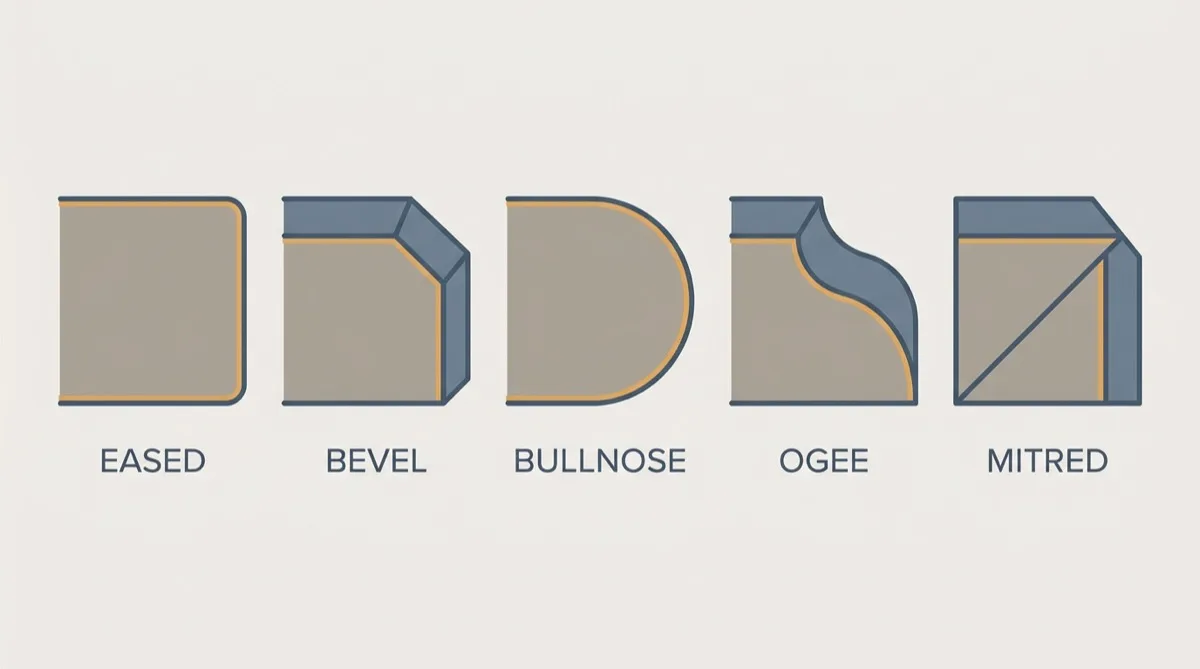
The edge profile is the last shop operation and the one most visible in the quote. A standard eased edge is included in the installed price at GTA fabricators. A bevel or bullnose adds $10 to $25 per linear foot, and an ogee or mitred profile adds $20 to $100 per linear foot, according to Countertop Pro GTA and Ottawa General Contractors, whose figures disagree widely inside that band. On a kitchen carrying 40 linear feet of exposed edge, that choice alone moves the invoice by hundreds or thousands.
Thickness decides how the top behaves once it is set. Stone Wizards describes 3 cm as the current Toronto standard and self-supporting, while 2 cm saves on material but needs plywood buildup and edge lamination that eats the saving. That is a fabrication decision as much as a material one, since the buildup is shop labour added to compensate for a thinner slab.
By the time the pieces reach the house, Toronto General Contractors prices granite at $75 to $175 per square foot templated, fabricated and installed, and puts a typical 40 square foot Toronto kitchen at $3,200 to $6,800 before HST. TecCorp Stone quotes entry-level granite at $55 to $80 per square foot installed and is explicit that its Level 1, 2 and 3 labels are commercial pricing categories set by each supplier rather than quality grades, so a slab sold as Level 2 at one shop can appear as Level 1 or Level 3 at another. Judge the slab in front of you and the written scope attached to it. The fuller granite cost picture sets those tiers side by side.
Frequently asked questions
How is a granite countertop made?
- A slab is selected at a yard, the kitchen is digitally templated once the cabinets are in and level, and the template drives a bridge saw and a CNC table in the shop. The slab is cut to shape, openings are machined, the edge is profiled and wet polished, and the finished pieces are delivered and set. Install day is placement and seaming.
Why can't granite be cut in my kitchen?
- Wet cutting, local exhaust ventilation, HEPA vacuums and a fitted respirator programme are shop conditions, not house conditions. Ontario's rules split the same way: O. Reg. 490/09 covers the fabrication shop and does not apply on a construction project, where the general duty in section 25(2)(h) of the Occupational Health and Safety Act applies instead. Bridge saws and CNC tables stay in the shop.
How many GTA companies actually fabricate stone?
- Of the 876 companies in the index, 77 are listed under stone fabrication and 120 under granite countertops. Google Maps labels 43 of the records granite supplier and 32 stone supplier, against 41 countertop contractor. That mix reflects a market where slab yards and fabrication shops are separate businesses that often sit on the same street.
Is buying the slab separately from the fabrication cheaper?
- Sometimes on paper. Floorence Tile and Slab, a Toronto supplier, puts slab material at $30 to $120 per square foot and slab installation labour at $25 to $60 per square foot. Splitting the two means you carry the risk on breakage, yield and seam planning yourself, which is the risk the fabricator normally absorbs inside a single installed number.
How much does granite cost installed in Toronto?
- Toronto General Contractors puts granite at $75 to $175 per square foot templated, fabricated and installed, and prices a typical 40 square foot Toronto kitchen at $3,200 to $6,800 before HST. TecCorp Stone quotes entry-level granite lower at $55 to $80 per square foot installed. Ontario HST of 13 percent goes on top of all of it.