Is a branded quartz slab worth the extra?
Last updated: By The Slab Desk
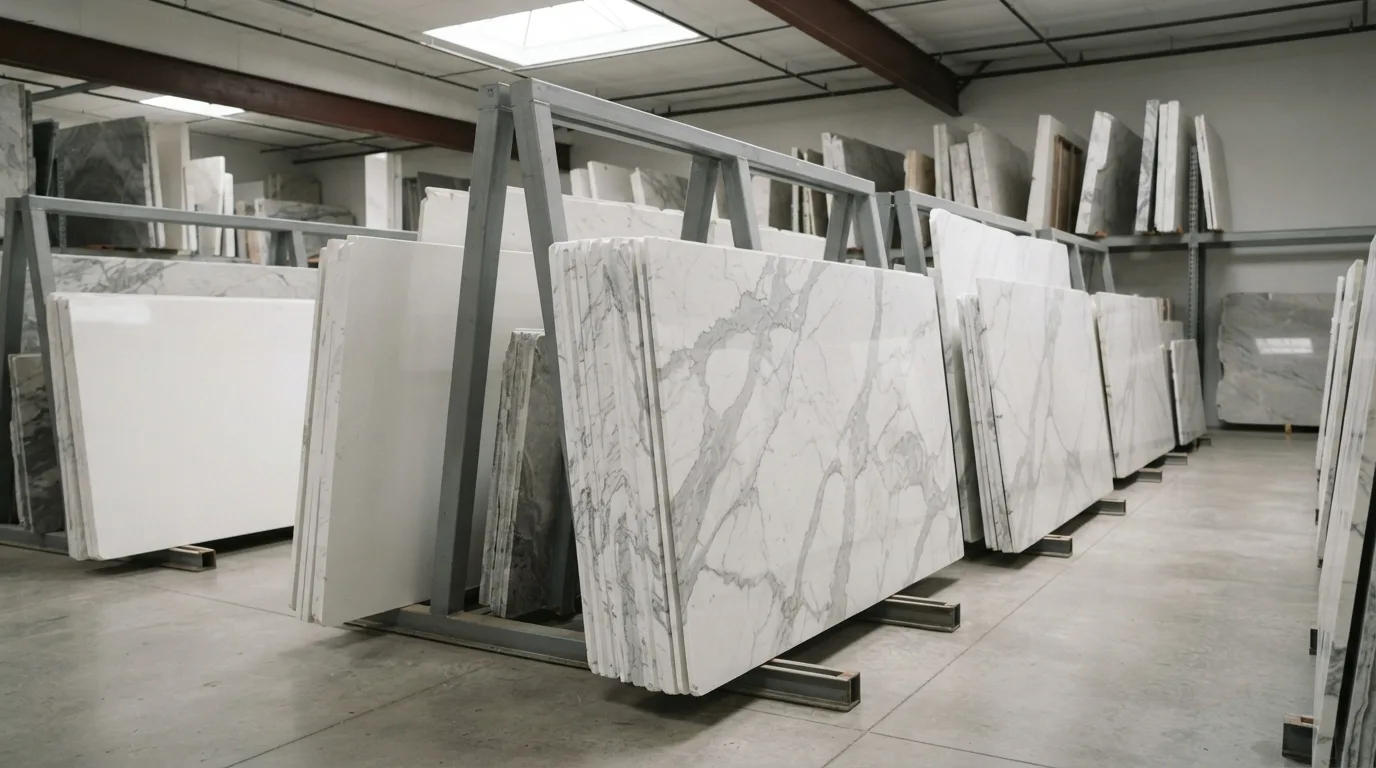
On a 40 square foot example kitchen, Caesarstone's row on Countertop Pro GTA's Toronto brand table runs $1,200 to $2,000 above KStone's, comparing floor with floor and ceiling with ceiling. The two rows meet at $85, so two real quotes can land much closer. The sources gathered here point to pattern as the main thing that gap pays for. Durability is argued both ways, with no published test behind either side.
The one durability lever the sources make concrete is slab thickness. A buyer can ask for it on any quote, whatever the brand.
Three GTA sources, three different tier lists
Countertop Pro GTA, an Etobicoke fabricator, lists eight quartz brands with a price range per square foot and a quality label on each row:
- High-end: Silestone at $100 to $150, Cambria at $90 to $140 and Caesarstone at $85 to $135.
- Mid-range: HanStone at $80 to $130, MSI Q Quartz at $75 to $120 and Vicostone at $70 to $110.
- Budget: KStone at $55 to $85 and Lucent Quartz at $50 to $80.
The page title calls these installed prices. The column heading reads only price range per square foot, and the rows carry no unit note. The same page also prints a generic tier list: entry-level at $55 to $80, mid-range at $80 to $110 and luxury at $110 to $180 or more. The two lists do not line up. Caesarstone's row, labelled high-end at $85 to $135, runs from the generic mid-range into luxury.
Stone Wizards, a Toronto fabricator, sorts the same names differently again. It places Caesarstone's standard collection, Silestone's mid-tier patterns and HanStone's core catalogue in its mid-range tier. Its premium tier is kept for top patterns such as Cambria Brittanicca and Caesarstone Calacatta Nuvo. Stone Valley Countertops in Mississauga names Caesarstone, Silestone and Vicostone together as premium slabs that cost more than generic or private-label options. Vicostone is a mid-range row on one list and a premium name on another.
Caesarstone sits in one high-end row of the first table but splits across two tiers in the second list, depending on the pattern. Countertop Pro GTA's quote checklist flags a quote that only says quartz, with no brand or collection name. For the two high-end rows buyers ask about most, Caesarstone against Silestone compares their two ranges.
Does the extra buy a tougher slab?
Stone Wizards says no. Its guide says all major brands use comparable chemistry, approximately 93 percent ground quartz and 7 percent polymer resin. Of its entry tier, it says installation quality and durability are identical to higher tiers because the base material is the same. It puts the price gap down to brand marketing, retail distribution and design research built into the slab price. Its entry tier covers its own direct-from-manufacturer line, Select, as well as value-tier branded quartz. It says Select delivers the same slab chemistry as a branded project. Stone Wizards sells Select itself, which is worth keeping in mind when weighing its view.
Two other sources lean the other way, more cautiously. Natural Stone City's Ontario cost guide says entry-level quartz may be less resistant to scratches or chips than higher-grade options. Its premium grade is described as designer brands with bold patterns, thick and durable, and highly resistant to scratches, heat and impact. Countertop Pro GTA writes that quartz brands come at different price points based on durability, design and warranty. That is its explanation of pricing, not a finding. Its installation page also lists Caesarstone, Cambria, Silestone, MSI, HanStone and Vicostone in its brand selection. Neither page cites a test result or a failure rate, and the guide arguing the other way cites none either.
Thickness is the one durability point the sources make concrete. Natural Stone City describes entry-level slabs as usually thinner, around 20mm, and premium slabs as often thicker and heavier. Countertop Pro GTA calls 3cm quartz thicker and more durable. Ikonyx's Toronto cost guide says thicker slabs are pricier but offer better durability. Those two make the point about thickness in general, whatever the brand. Stone Wizards calls 3cm the current standard for kitchens, while Stone Valley Countertops calls 2cm standard for GTA homes. Two shops may therefore quote from different defaults, so ask for both quotes at the same thickness.
What the extra money actually buys
Pattern is the clearest answer. Stone Valley Countertops sorts its installed prices by look, not by brand. Its A-grade tier, at $65 to $85 per square foot, covers popular whites, light veining and subtle patterns. Its premium tier, at $110 to $180 or more, covers dramatic veining, marble-look slabs, bookmatching and ultra-white designs. Stone Wizards says the same colourway from a premium brand looks more dimensionally realistic than the entry version. In its view, whether that is worth the price depends on how much the kitchen design features the countertop as a focal point.
Slab count can add to the bill too. Tec Corp Group's Toronto cost guide notes that a product with dramatic movement may cost more because of the collection itself. It adds that the project total can also rise when additional slab area is needed to preserve the intended pattern. A quote for a heavily veined slab should say how many slabs it assumes. The slab size and seams guide covers how a layout uses a slab.
Warranty is where the brands make written promises. Caesarstone's Canadian site says its lifetime warranty applies for certain residential and commercial indoor products, subject to its provisions. It adds that you must register to activate the warranty. Cambria's US site describes a transferable Full Lifetime Warranty. The warranty terms of the two budget brands could not be checked for this guide, so that comparison stays open. Natural Stone City notes that many manufacturers require professional installation to keep the warranty.
How far apart the tiers sit on a 40 square foot kitchen
The arithmetic below uses 40 square feet of countertop as an example kitchen. On the brand table the bands overlap. High-end rows run $85 to $150 per square foot and mid-range rows $70 to $130. A Caesarstone figure near its $85 floor can come in below a HanStone figure near its $130 ceiling, so dropping a tier can save little or nothing.
Four pairs one tier apart on the same table show the spread. Each line compares floor with floor and ceiling with ceiling:
- Caesarstone ($85 to $135) against HanStone ($80 to $130): $5 per square foot at each end, or $200 on 40 square feet.
- Silestone ($100 to $150) against Vicostone ($70 to $110): $30 to $40 per square foot, or $1,200 to $1,600.
- MSI Q Quartz ($75 to $120) against KStone ($55 to $85): $20 to $35 per square foot, or $800 to $1,400.
- HanStone ($80 to $130) against Lucent Quartz ($50 to $80): $30 to $50 per square foot, or $1,200 to $2,000.
Every pair one tier apart on the table falls between the first and last of these, $5 to $50 per square foot, or $200 to $2,000 on 40 square feet. Price the same layout with both slabs before counting on any of these gaps.
Stone Valley Countertops' installed grades sit close together. A-grade tops out at $85, where B-grade starts, and premium starts at $110, just above B-grade's $105 ceiling. Stone Valley describes its A-grade and premium grades by look, so on its list the step from premium to A-grade is also a step in pattern.
Add-ons come on top of these rates. Countertop Pro GTA's custom-installation page says premium edges add $25 to $100 per linear foot. The same page says waterfall islands add $1,000 to $2,500 or more, about the size of the Silestone and Vicostone gap above. Per-line prices from other GTA shops are set out in the guide to three comparable quotes.
Reading a quote at the bottom of the range
A very low per-square-foot figure may describe the slab alone. Natural Stone City says basic quartz slabs, material only, start around $40 to $60 per square foot. It puts entry-level quartz with fabrication and professional installation at $50 to $85. Tec Corp Group tells buyers to compare complete project quotations, not only an advertised square-foot rate.
The published GTA ranges do not agree on a headline number. Stone Wizards gives $45 to $180 per square foot installed, with most of its Select projects between $45 and $95. Stone Valley Countertops says most GTA homeowners pay $65 to $120 fully installed. Tec Corp Group calls approximately $75 to $140 or more a planning range. Natural Stone City puts the GTA at $85 to $160 installed, a figure that covers mid-range to premium quartz only.
Before comparing a branded quote with a budget one, ask each fabricator to state:
- The brand, collection and colour, since one brand can sit in two tiers depending on the pattern.
- The slab thickness, and for 2cm, whether plywood support and edge build-up are included.
- The number of slabs, and whether extra slab area is needed to keep a vein pattern continuous.
- Whether the per-square-foot figure is installed, and which edge, cut-outs and backsplash it covers.
Then have a second shop price the same collection and colour, so the brand is held constant.
What this index can say about brands
The index holds 876 listings, each with a name, an area and the categories it is filed under. It has no field for which slab brands a company carries, so it cannot confirm that a given fabricator can order a given line. Quartz Countertops holds 175 of those listings, a count of businesses filed under the material.
Six listings begin with one of the brand names on the table:
- Kstone Group Ltd., recorded in Vaughan.
- Lucent Quartz, recorded in Richmond Hill.
- Vicostone, recorded in Vaughan.
- Caesarstone Vaughan Design Centre & Warehouse, recorded in Vaughan.
- Cambria Gallery - Toronto.
- Cambria Sales and Distribution Center Showroom - Toronto, recorded in Richmond Hill.
The records do not state a corporate relationship with any brand, and this index does not assert one. Caesarstone against Silestone looks at the one Caesarstone-named listing and the absence of a Silestone one.
The practical use of the listings is to build a shortlist by area and category, then put the checklist above to each shop. Published figures for the money side sit in quartz countertop costs in Toronto. For a vanity or another small piece, minimum job charges explains how shop minimums work.
Frequently asked questions
Is branded quartz better quality than budget quartz?
- The sources disagree, and none cites a test. Stone Wizards says all major brands share roughly 93 percent ground quartz and 7 percent resin, and that its entry tier matches higher tiers on durability. Countertop Pro GTA says brand prices reflect durability, design and warranty. Natural Stone City says entry-level quartz may be less resistant to scratches or chips. It also describes entry-level slabs as usually thinner, so check thickness on each quote.
How much does a premium quartz brand cost in Toronto?
- Countertop Pro GTA's Toronto brand table lists Silestone at $100 to $150 per square foot, Cambria at $90 to $140 and Caesarstone at $85 to $135, all labelled high-end. Its page title calls these installed prices, but the rows carry no unit note. Stone Valley Countertops sorts installed prices by look and puts premium quartz at $110 to $180 or more per square foot. Ask which collection a quote prices.
How much do I save by dropping one quartz tier?
- Often less than the tier labels suggest. On Countertop Pro GTA's table, high-end rows run $85 to $150 per square foot and mid-range rows $70 to $130. Caesarstone against HanStone differs by $5 per square foot at each end, while Silestone against Vicostone differs by $30 to $40. On a 40 square foot example kitchen that is $200 or $1,200 to $1,600. Price the same layout with both slabs before deciding.
Why do two quartz quotes for the same kitchen differ so widely?
- Often because they price different scope. Natural Stone City says basic quartz slabs, material only, start around $40 to $60 per square foot. It puts entry-level quartz with fabrication and installation at $50 to $85. Stone Wizards says premium edges and backsplash are almost always quoted separately, and cooktop and specialty cut-outs typically are too. It calls comparing the same scope the most important thing when reading quotes.
Does the brand matter for a small vanity top?
- On a small top the brand gap shrinks with the area, unless a shop minimum applies. CGD Cabinetry reports that many Toronto and Mississauga fabricators set a minimum project size of around 35 to 40 square feet, so a 20 square foot vanity may be charged for more. Any per-square-foot brand gap then applies to the billed area. Countertop Pro GTA suggests remnant slabs for vanities to reduce material waste.
Sources
Several of these sources are GTA companies that also have listings in this directory. They are cited for what their own pages publish, and being cited has no effect on where a listing appears.
- Countertop Pro GTA's Toronto table labels Silestone ($100 to $150), Cambria ($90 to $140) and Caesarstone ($85 to $135) high-end, HanStone, MSI Q Quartz and Vicostone ($70 to $130) mid-range, and KStone and Lucent Quartz ($50 to $85) budget, per square foot. The page title calls these installed prices; the rows carry no unit note. Countertop Pro GTA (Etobicoke) - Quartz Countertops Cost Toronto: Installed Prices and Quote Factors, posted March 2025, updated August 2026
- Countertop Pro GTA says premium edges add $25 to $100 per linear foot and waterfall islands add $1,000 to $2,500 or more. Countertop Pro GTA - Custom Quartz Countertop Installation Cost, Toronto
- Stone Wizards says all major quartz brands use approximately 93 percent ground quartz and 7 percent polymer resin, and that its entry tier matches higher tiers on durability. Stone Wizards (Toronto) - Quartz Countertops Cost in Toronto, last updated April 2026
- Stone Valley Countertops prices A-grade quartz at $65 to $85, B-grade at $85 to $105 and premium at $110 to $180 or more per square foot installed. Stone Valley Countertops (Mississauga) - Quartz Countertop Pricing Guide GTA
- Natural Stone City says basic quartz slabs, material only, start around $40 to $60 per square foot, and that entry-level quartz may be less resistant to scratches or chips than higher grades. Natural Stone City - Quartz Countertop Cost Guide, What You'll Really Pay in Ontario
- Tec Corp Group gives approximately $75 to $140 or more per square foot installed as a planning range and says pattern-preserving extra slab area can raise a project total. Tec Corp Group (Toronto) - Quartz Countertop Cost in Toronto, Installed Pricing Breakdown
- Ikonyx says thicker quartz slabs are pricier but offer better durability. Ikonyx (Toronto) - Cost of Quartz Countertops in Toronto
- Many Toronto and Mississauga fabricators set a minimum project size of around 35 to 40 square feet. CGD Cabinetry - The Complete Homeowner's Guide to Quartz Countertops in the GTA
- Caesarstone Canada says its lifetime warranty applies for certain residential and commercial indoor products, subject to its provisions, and must be registered to activate. Caesarstone Canada - Warranty
- Cambria describes its quartz warranty as a transferable Full Lifetime Warranty. Cambria - Full Lifetime Warranty