Planning an island top before the cabinets
Last updated: By The Slab Desk
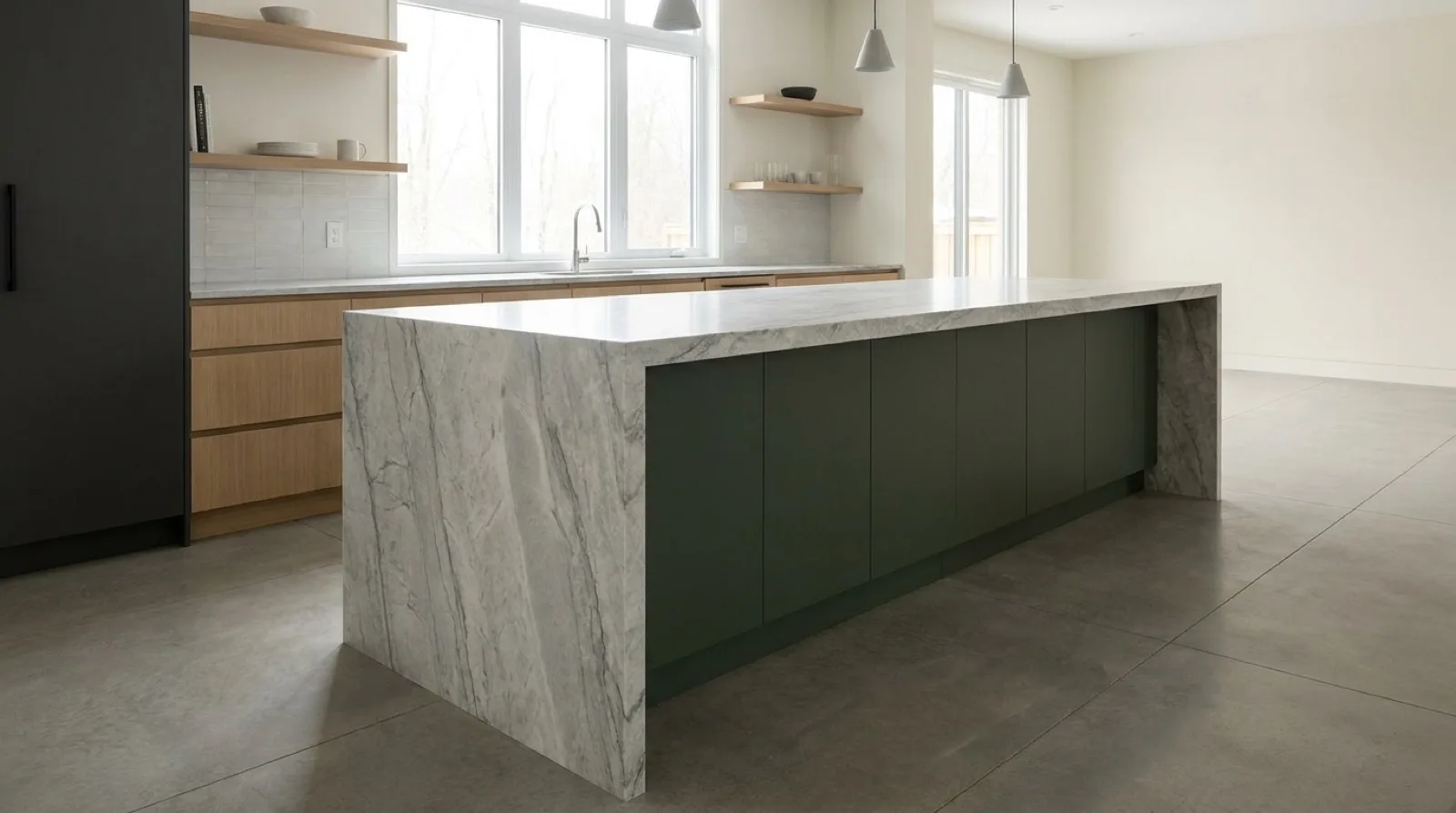
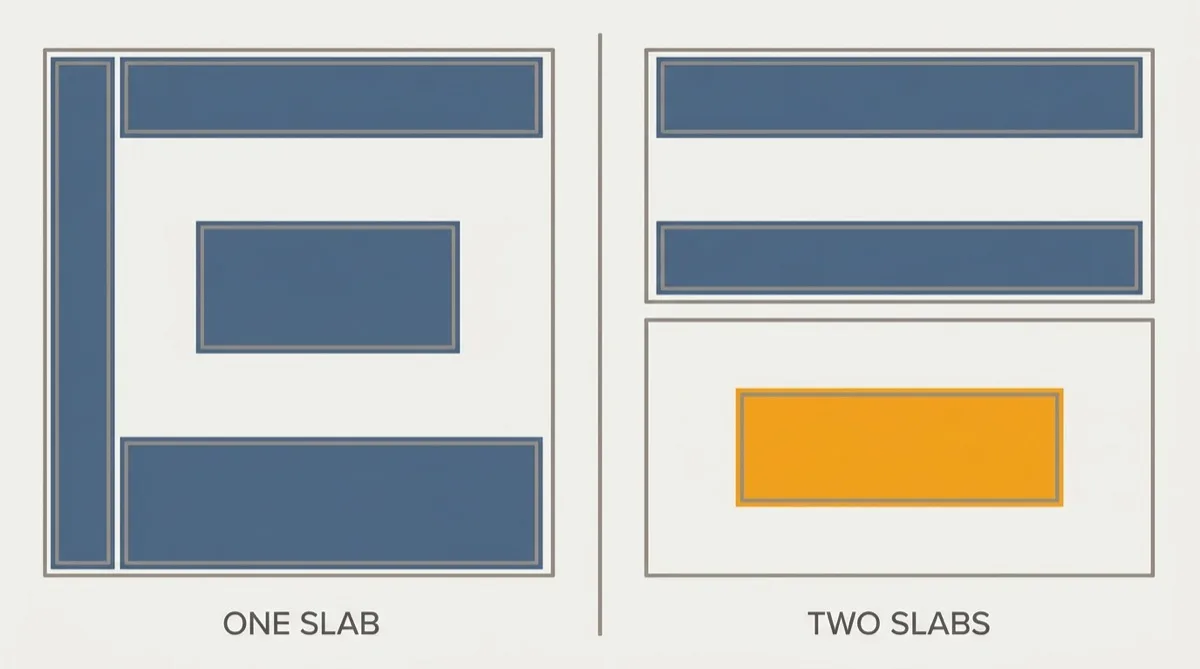
An island top is bought by the slab rather than by the square foot. Adding a few inches of length can push the job onto a second slab, and a piece that fits the kitchen can still be too big to get into the building. Both decisions are made when the cabinets are ordered, months before anyone measures stone.
The slab is the unit of purchase
Two GTA fabricators make the same point in the same words. Countertop Pro GTA and Tec Corp Group both note that needing a second slab changes the total independently of square footage, and Tec Corp Stone and Stone Valley add that a small change to island length or width can be the difference between one slab and two. The arithmetic homeowners do in their heads, price per square foot times area, breaks down exactly here.
On marble the consequence is blunt. Better Marble's Toronto breakdown prices the slab alone at $60 to $250 per square foot before fabrication and installation, and a second slab bought only to cover a few extra inches of island is the single largest avoidable cost on the job. Quartz behaves the same way with different numbers: Stone Wizards puts installed quartz in Toronto at $45 to $180 per square foot with most of its projects at $45 to $95, and none of that band tells you whether your island crosses a slab boundary. The question to ask a fabricator before the cabinet order concerns the usable dimensions of the slab you like, and whether the island layout fits inside them alongside the perimeter runs.
What a waterfall costs, per side and per island
The waterfall panel is the most expensive detail commonly specified on a GTA island, and the two published ways of pricing it are not interchangeable. Stone Valley Countertops prices a mitred waterfall edge at $900 to $1,800 per island side, which makes a two-sided island $1,800 to $3,600. Countertop Pro GTA prices the same feature as a whole-island addition of $1,000 to $2,500 or more. Read the two together and the honest planning range is $900 to $1,800 per mitred side from Stone Valley Countertops, or $1,000 to $2,500 or more for the island as a whole from Countertop Pro GTA, and any single figure quoted at you should be checked against which of those two units it uses.
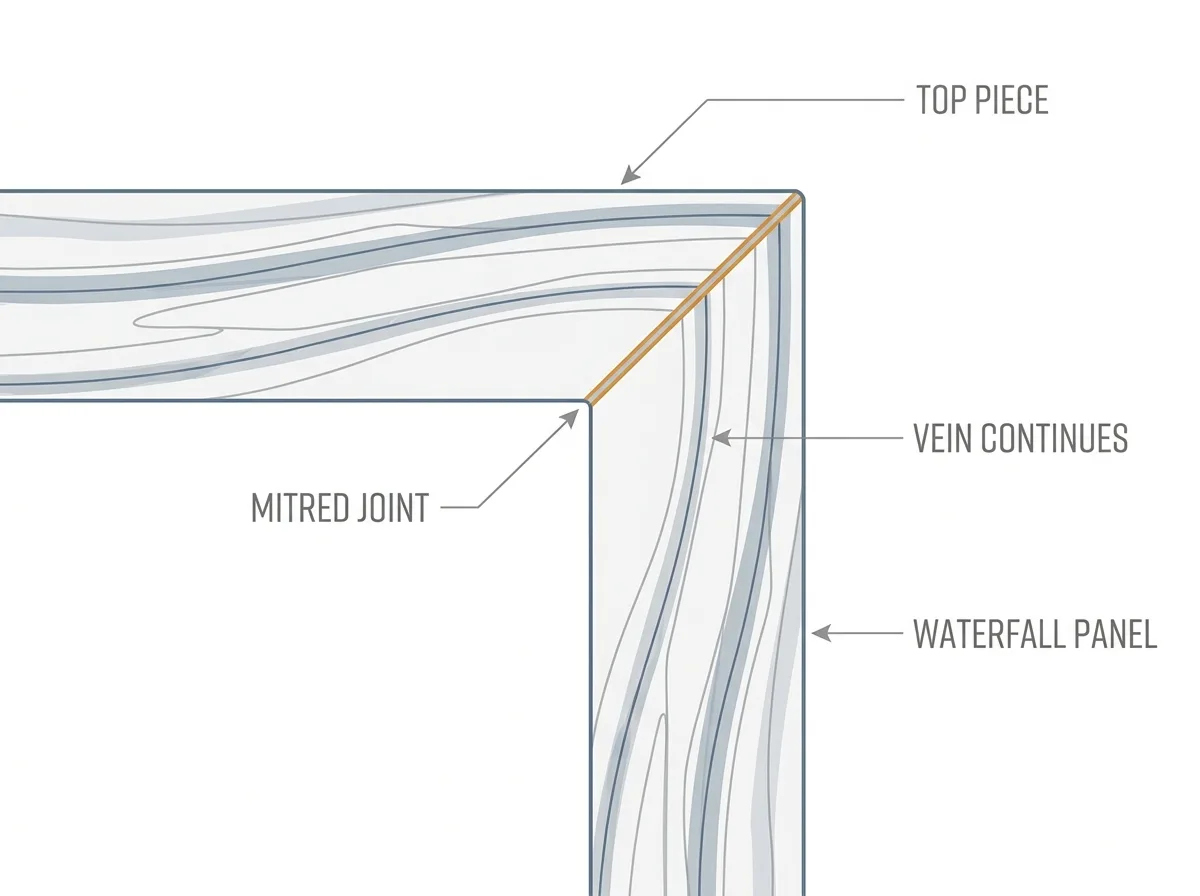
A waterfall consumes considerably more slab, and it requires a precision mitred joint with the veining aligned across the corner so the pattern appears to run down the leg. That alignment requirement is what ties the feature back to the slab question: a book-matched or vein-matched layout forces pieces to be cut in a specific orientation, which Tec Corp Stone and Stone Valley both note can require a second slab even when the square footage looks modest. Skipping the waterfall and keeping the standard eased edge is the largest single reduction available on an island, since Countertop Pro GTA prices premium edge profiles at $25 to $100 per linear foot over the included eased edge.
The building can force a seam the kitchen does not need
Teccorp Stone lists what has to be confirmed before fabrication on a condo or high-rise job: freight elevator availability and reservation requirements, loading dock access and permitted delivery times, protection requirements for elevators, corridors and common areas, and the maximum countertop section size the delivery route allows. That last item is the one that reaches back into the design.
The failure mode is specific. A large island or long countertop section may fit in the kitchen and still be impossible to move through the building entrance, the elevator or the unit door. The slab layout and seam plan should therefore be approved only after the access route is measured, and a one-piece island that clears the route may still need extra installers or specialised handling equipment. For a homeowner who chose a slab for its uninterrupted veining, learning on delivery day that the piece has to be cut in two is the worst possible time to find out. Corridor turns, door widths and elevator cab dimensions are free to measure and take an afternoon.
Overhang, seating and where support gets settled
An island that seats people has an overhang, and the overhang is where thickness stops being a cosmetic choice. GTA fabricators do not agree on standard thickness: Stone Wizards says 3cm is the current industry standard for Toronto kitchens and that 2cm often needs plywood support and edge build-up that eats the saving, while Stone Valley Countertops says 2cm is standard for GTA homes and that 3cm adds cost and heavier lifting. Countertop Pro GTA prices 3cm at 10 to 20 percent more, roughly $300 to $1,000 on a $3,600 to $6,500 kitchen.
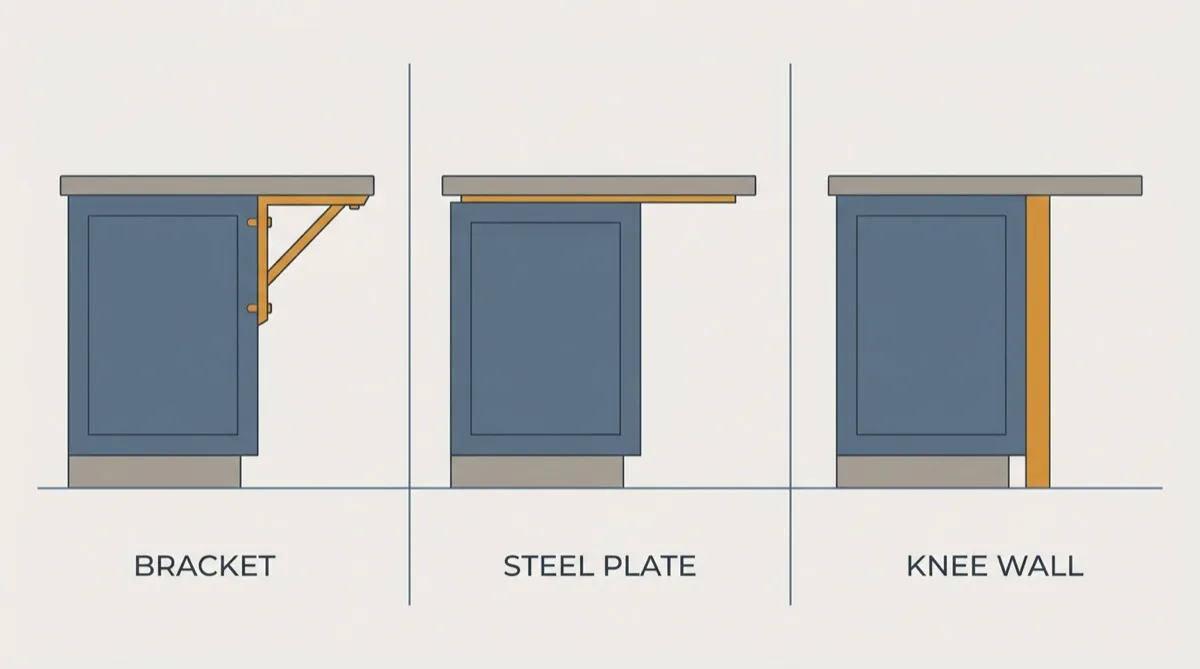
Whichever thickness a quote assumes, the support detail under a seating overhang is designed into the cabinet, which is why it belongs in the cabinet conversation rather than the stone one. Brackets, a steel plate or a knee wall all change the cabinet drawing and the finished dimensions of the island box. Deciding the seating depth after the cabinets are built leaves two options, both bad: shrink the overhang, or add visible support that was never part of the design.
Who fabricates islands in this market
Of the 876 companies in this index, 77 are listed under Stone Fabrication. That sits alongside 175 under Quartz Countertops, 120 under Granite Countertops, 110 under Marble Countertops and 300 under Countertop Installation. Fabrication is the smaller label because most GTA shops sell shop work bundled inside an installed price per square foot rather than as a separate line, so a company doing plenty of cutting may list itself under the material instead.
Geography follows the industrial land rather than the kitchens. Vaughan holds 97 companies in the index and Mississauga 93, with North York at 92, Brampton at 71 and Etobicoke at 44. Shops carrying the Stone Fabrication label include Marble Guys in Etobicoke, listed under Stone Fabrication and Marble Countertops, Hilltop Surfaces in Mississauga under Stone Fabrication and Quartz Countertops, Majestic Marble Import in Vaughan under Marble Countertops, Stone Fabrication and Granite Countertops, and Cava Surfaces in North York under Quartz Countertops, Marble Countertops and Stone Fabrication. Across the 845 rated companies in the index the mean rating is 4.7 and the median is 4.9, which is a narrow spread on a small sample and not a way to separate one shop from another. The category page is stone fabrication, with rate detail at stone fabrication cost in Toronto.
Template day is the point of no return
Templating happens after the base cabinets and island are installed, secured and levelled, because the template records the room rather than the drawing. Teccorp Stone treats the approved template as the production reference and warns that a change after cutting starts can mean re-fabricating a section at full cost. The same source advises finalising the sink, faucet and cooktop before template day and not moving cabinets afterwards.
Working backwards from that, the island's real deadline is the cabinet order. Length, width, overhang depth, whether a cooktop or a second sink lands in the island, and how many cutouts the top will carry are all fixed by the boxes that arrive. Stone Valley Countertops prices an undermount sink cutout at $250 to $350 and a cooktop cutout at $250 to $450, and a full-height backsplash at $900 to $2,200 or more, so the island's feature list is a budget line long before it is a construction detail. Whole-project context sits at quartz countertop cost in Toronto, where Countertop Pro GTA puts a large kitchen with an island at 50 or more square feet and $5,500 to $9,000 all-in, and at marble countertop cost in Toronto for the natural stone comparison. Companies by area are at Vaughan and Mississauga.
Frequently asked questions
Why does island size change the price more than square footage does?
- Because stone is bought by the slab. Countertop Pro GTA and Tec Corp Group both note that needing a second slab changes the total independently of square footage, and Tec Corp Stone and Stone Valley add that a small change in island length or width can be the difference between one slab and two. A few extra inches can cost more than a few extra feet.
What does a waterfall island add to a GTA quote?
- Stone Valley Countertops prices a mitred waterfall edge at $900 to $1,800 per island side, so a two-sided island is $1,800 to $3,600. Countertop Pro GTA prices the same feature as a whole-island addition of $1,000 to $2,500 or more. The panels cost that much because they consume extra slab and need a precision mitred seam with the veining aligned across the corner.
Can a building force a seam in an island top?
- Yes. Teccorp Stone notes that a large island or long countertop section may fit in the kitchen and still be impossible to move through the building, so the slab layout and seam plan should be approved only after the access route is measured. Elevator dimensions, corridor turns and unit door widths cap the maximum section size.
How many GTA companies list stone fabrication?
- Of the 876 companies in this index, 77 are listed under Stone Fabrication, alongside 175 under Quartz Countertops, 120 under Granite Countertops and 110 under Marble Countertops. Fabrication is the smaller label because most GTA shops sell it bundled inside an installed price per square foot rather than as a separate service.
When is the last moment to change an island's dimensions?
- Before the template is approved. Teccorp Stone treats the approved template as the production reference and warns that a change after cutting starts can mean re-fabricating a section at full cost. Since templating happens after the base cabinets and island are installed, secured and levelled, the practical deadline is earlier still: the cabinet order.